



You have probably heard about Ozempic. You have probably heard about Wegovy. And if
you have been paying attention to health news lately, you know that GLP-1 receptor
agonists have taken over the conversation in a way that no class of medication has in
decades.
But here is what most of that conversation gets wrong: it starts and ends with the number
on the scale.
GLP-1 medications were never just a weight loss tool. They were developed as metabolic
medications — and the science is now making clear that their reach goes far beyond how
much you weigh. Researchers, cardiologists, nephrologists, and neurologists are all paying
attention. It is time patients did too.
What Is a GLP-1, Really?
GLP-1 stands for glucagon-like peptide-1, a hormone your gut naturally produces after you
eat. It signals your pancreas to release insulin, tells your brain you are full, and slows
digestion. GLP-1 receptor agonists (GLP-1 RAs) are medications that mimic and amplify this
signal.
They were first approved for type 2 diabetes. Then for obesity. But what scientists
discovered along the way changed everything: GLP-1 receptors are not just in your gut.
They are in your heart, your kidneys, your brain, your immune cells, and your liver. Which
means these drugs do not just affect your appetite. They affect your entire metabolic
system.
What the Research Actually Shows
Your Heart
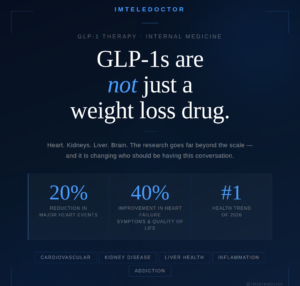
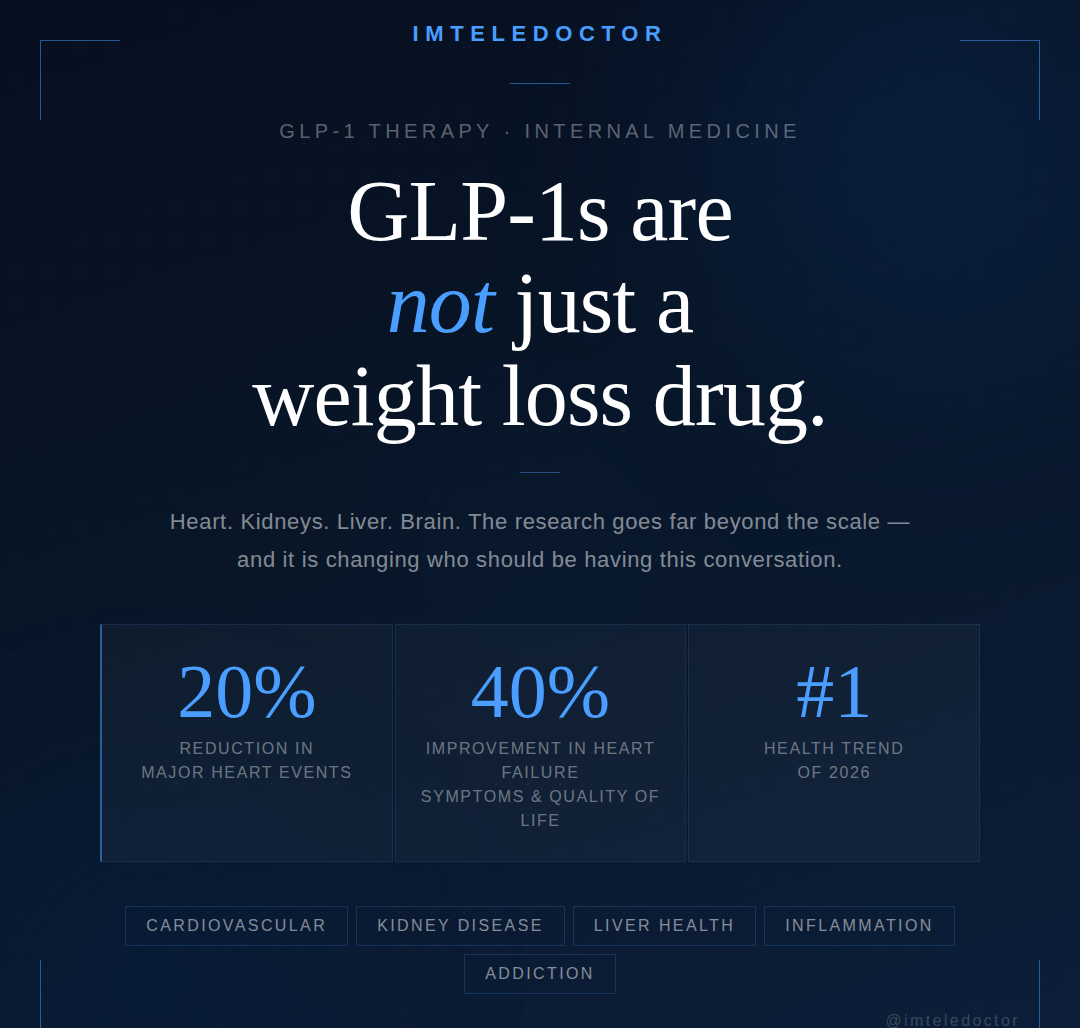
This is where some of the most compelling data lives. In a landmark clinical trial called
SELECT, adults with obesity and established cardiovascular disease who took semaglutide
had approximately a 20% lower risk of heart attack, stroke, or cardiovascular-related death
— and this benefit was independent of weight loss. The drug itself was doing something
protective.
GLP-1s have also shown meaningful results in heart failure with preserved ejection fraction
(HFpEF), a condition where the heart muscle becomes too stiff to fill properly. One study
found a 40% improvement in outcomes in this patient population — a group that historically
has had very few good treatment options.
Your Kidneys
Chronic kidney disease (CKD) affects more than 37 million Americans, and most of them
have no idea. GLP-1 receptor agonists have now been shown to slow the progression of
kidney disease and, in some cases, reduce the risk of kidney failure. This is not a side effect
— it is a documented mechanism of the drug class.
For patients managing type 2 diabetes, high blood pressure, or metabolic syndrome, kidney
protection is not a bonus feature. It is a reason to have a serious conversation with your
provider.
Your Liver
Metabolic dysfunction-associated steatotic liver disease (MASH) — previously called NASH
— is now the leading cause of liver transplants in the United States. The FDA approved
semaglutide (Wegovy) for treating MASH in adults with significant liver scarring. GLP-1s
have been shown to reverse liver fibrosis, not just slow it.
Inflammation
Here is what connects all of the above: inflammation. Chronic, low-grade systemic
inflammation is the underlying driver of heart disease, kidney disease, liver disease, and
dozens of other conditions. GLP-1s have documented anti-inflammatory effects that are
independent of both glucose control and weight loss — they appear to work directly through
immune GLP-1 receptors throughout the body.
This is why researchers are now studying GLP-1s for conditions like arthritis, inflammatory
bowel disease, and even certain cancers.
Sleep Apnea
Tirzepatide (Zepbound) is now FDA-approved for adults with obesity who also have obstructive sleep apnea — a condition
linked to cardiovascular disease, cognitive decline,and metabolic dysfunction. Clinical trials showed significantly reduced
breathinginterruptions during sleep, lowered inflammation markers, and improved quality of life.
The Brain and Addiction
This one surprised even the researchers. Patients started reporting that when they began
GLP-1 therapy, they were not just eating less — they were also drinking less alcohol,
smoking less, and experiencing fewer compulsive urges. Anecdotal reports have now been
followed by formal studies. GLP-1 receptors are present in the brain’s reward pathways, and
the data on addiction is building quickly.
Research published in the BMJ found that GLP-1 users had significantly lower rates of
substance use disorders. Studies are underway for alcohol use disorder, nicotine
dependence, and opioid use disorder. This is a new frontier in addiction medicine.
So Why Does Everyone Only Talk About Weight?
Because weight is visible. Because it sells. And because when you lose 15% of your body
weight, it is easy to attribute everything good that followed to that number.
But the science does not support the idea that weight loss alone explains what GLP-1s are
doing in the body. Experts are now calling for the entire framing to shift — from “weight loss
drug” to multi-system metabolic modulator.
The implications are significant. Patients who have been told they “do not qualify” for GLP-1
therapy because their BMI is not high enough may actually be strong candidates based on
their cardiovascular risk profile, inflammatory markers, kidney function, or liver health.
Who Should Be Having This Conversation?
If any of the following apply to you, a GLP-1 evaluation may be worth discussing —
regardless of your weight:
Cardiovascular disease or elevated risk of heart attack or stroke
Chronic kidney disease or declining kidney function
Metabolic dysfunction-associated liver disease
Obstructive sleep apnea
Chronic systemic inflammation
Type 2 diabetes or insulin resistance
A history of difficulty with compulsive behaviors, including alcohol or tobacco use
How IMTELEDOCTOR Approaches GLP-1 Therapy
At IMTELEDOCTOR, we do not evaluate GLP-1 candidacy by BMI alone. Dr. Carlos H. Silva,
MD looks at the full metabolic picture — cardiovascular risk, inflammatory markers, kidney
and liver function, and your personal health history — to determine whether GLP-1 therapy
is appropriate for you and, if so, which medication and which approach makes the most
sense.
This is internal medicine. Not a weight loss clinic. Not a telehealth shortcut. A real clinical
evaluation from a board-certified physician who understands what these medications
actually do.
If you have questions about GLP-1 therapy, or if you have been dismissed as “not a
candidate,” we encourage you to schedule a consultation. The conversation is worth having.
This content is for informational purposes only and does not constitute medical advice.
Please consult a qualified healthcare provider before starting any new medication or
treatment.
References
Lincoff AM, Brown-Frandsen K, Colhoun HM, et al. Semaglutide and Cardiovascular
Outcomes in Obesity without Diabetes. New England Journal of Medicine.
2023;389(24):2221-2232. https://doi.org/10.1056/NEJMoa2307563
Vaduganathan M, Docherty KF, Claggett BL, et al. STEP-HFpEF Trial: Semaglutide in
Heart Failure with Preserved Ejection Fraction. New England Journal of Medicine.
2023;389(12):1097-1107. https://doi.org/10.1056/NEJMoa2306963
Perkovic V, Tuttle KR, Rossing P, et al. Effects of Semaglutide on Chronic Kidney Disease
in Patients with Type 2 Diabetes. New England Journal of Medicine. 2024;391(2):109-
121. https://doi.org/10.1056/NEJMoa24033474.
Newsome PN, Buchholtz K, Cusi K, et al. A Placebo-Controlled Trial of Subcutaneous
Semaglutide in Nonalcoholic Steatohepatitis. New England Journal of Medicine.
2021;384(12):1113-1124. https://doi.org/10.1056/NEJMoa2028395
Drucker DJ. The expanding landscape of GLP-1 medicines. Nature Medicine.
2026;32:47-57. https://doi.org/10.1038/s41591-025-04124-5
Drucker DJ. The benefits of GLP-1 drugs beyond obesity. Science.
2024;385(6706):258-260. https://doi.org/10.1126/science.adn4128
Al-Aly Z, et al. Glucagon-like peptide-1 receptor agonists and risk of substance use
disorders among US veterans with type 2 diabetes: cohort study. BMJ.
2026;392:e086886. https://doi.org/10.1136/bmj-2025-086886
Malhotra A, Grunstein RR, Fietze I, et al. Tirzepatide for the Treatment of Obstructive
Sleep Apnea and Obesity. New England Journal of Medicine. 2024;391(13):1193-1205.
Vaduganathan M. What’s next for GLP-1s? Harvard Gazette. February 2026
U.S. News Health Panel. GLP-1 ranks as No. 1 health trend for 2026. Food Business
News. January 2026. https://www.foodbusinessnews.net/articles/29573-glp-1-ranks-as-
no-1-health-trend-for-2026